
A non-surgical facelift is one of the most searched aesthetic treatments today. However, the term is used for almost everything, from serious medical technologies to creams with bold promises. So, how can you separate real lifting from marketing?
In this article, Dr. Julia Ocampo, a dermatologist in São Paulo and Rio de Janeiro, explains what actually lifts the face. She also shows what only looks good in advertising.
Why the face sags in the first place
Facial aging is not only about the skin. In fact, it happens in several layers at the same time. The bone slowly loses projection. The fat pads shrink and slide down. Meanwhile, ligaments lose strength. Finally, the skin produces less collagen and elastin.
Because of this, a single product rarely solves everything. A good plan looks at every layer and treats the main causes, not just the most visible fold.
What a non-surgical facelift can really do
First of all, it is important to set realistic expectations. A non-surgical facelift does not remove excess skin. That is the role of surgery.
On the other hand, it can firm, support and reposition tissues in a subtle way. For mild to moderate laxity, the result can be very natural. Also, recovery is usually quick, and most people return to work the same day or the next.
Non-surgical facelift treatments that truly lift
1. Microfocused ultrasound. This technology delivers heat to deep layers, including the SMAS. That is the same layer a surgeon tightens during a facelift. As a result, the tissue contracts and new collagen forms over two to three months.
2. Collagen biostimulators. Products such as poly-L-lactic acid and calcium hydroxylapatite stimulate your own collagen. Therefore, the skin becomes firmer and thicker over the following months. See what to expect in our article on biostimulator results.
3. Strategic hyaluronic acid. Small amounts in key support points, such as the temples, cheekbones and jawline, can restore structure. In other words, the filler works like a scaffold, not like a balloon.
4. Radiofrequency. Radiofrequency, alone or combined with microneedling, heats the dermis and improves firmness. It is especially useful for skin quality and early sagging.
5. Botulinum toxin, in specific cases. Toxin can relax muscles that pull the face down. For example, small doses can lift the tail of the brow or soften neck bands.
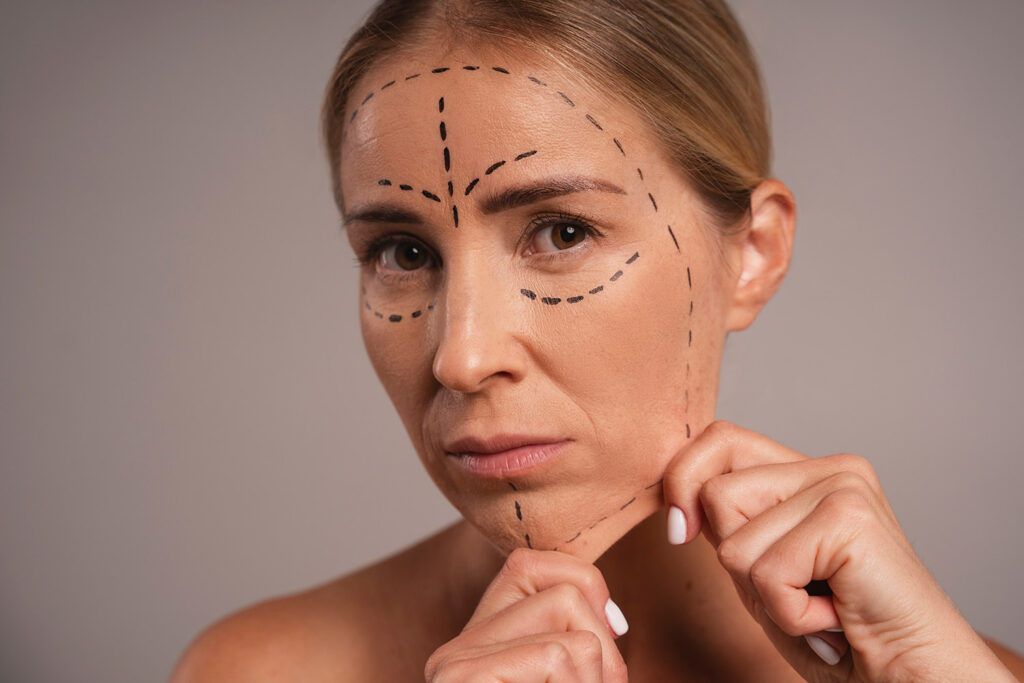
What is mostly marketing
Unfortunately, some promises do not match the science. Be careful with:
- creams that claim to work like a surgical lift;
- one-session miracle offers made without a medical evaluation;
- large volumes of filler used to pull the face up, which often look heavy;
- devices without regulatory approval or with unclear technology;
- before-and-after photos with different lighting, angles or makeup.
Also, facial exercises and massage may help you feel good. Still, they do not tighten deep tissues in a meaningful way.
Who is a good candidate for a non-surgical facelift?
In general, the best candidates have mild to moderate laxity and reasonable skin quality. Moreover, they want a gradual and discreet change.
On the other hand, people with heavy excess skin usually get more from surgery. Even so, non-surgical treatments can help as a complement, before or after the operation.
Why combining treatments works better
Each technology acts on a different layer. For this reason, the most natural results usually come from a combination.
For example, ultrasound tightens deep tissue, a biostimulator improves firmness, and a small amount of filler restores support. Together, they create a fresher face that still looks like you.
How long do the results last?
Results are not permanent, because aging continues. Still, most collagen-based treatments last from one to two years. After that, maintenance sessions help keep the effect.
Ideally, you should plan your non-surgical facelift over time, not as a one-time event. This way, small and regular steps keep the face natural.
Expert evaluation comes first
Before any procedure, a dermatologist should examine your face at rest and in motion. In addition, the doctor must explain risks, recovery and realistic goals. The American Academy of Dermatology also recommends choosing a board-certified dermatologist for cosmetic procedures.
Dr. Julia Ocampo sees patients in Itaim Bibi, São Paulo, and in Ipanema, Rio de Janeiro. If you want a personalized plan, book your consultation.


